· By the MobiPOS team at HixCode
How to Offer Installment Plans in Your Shop (In-Store Buy Now, Pay Later)
Many customers want a new phone, laptop, TV or motorbike today but can't pay the full price in one go. An in-store installment plan — sometimes called in-house financing, a shop payment plan or in-store "buy now, pay later" — lets them take the item home after a down payment and pay the rest in fixed weekly or monthly amounts directly to your shop.
Done well, installment plans bring in customers your competitors turn away and keep them coming back. Done badly, they tie up your cash in unpaid balances. This guide explains how to set them up properly.
In-house plans vs third-party "buy now, pay later"
There are two ways to let customers pay over time:
- Third-party financing (BNPL providers, banks, finance companies): the provider pays your shop up front and collects from the customer. You carry little or no default risk, but you pay a fee on each financed sale — often quoted in the range of a few percent of the sale — and these services are only available in some countries and to some customers.
- In-house installment plans: your shop gives the credit and collects the payments. You keep the full margin and can serve customers lenders won't, but you carry the risk and the paperwork.
Many shops use both: third-party financing where it's available, and in-house plans for trusted local customers. In your POS, a third-party-financed sale is simply a sale paid by card or bank transfer. Only in-house plans need an installment schedule.
Step 1: Decide your plan rules before the first sale
Write down a short policy and apply it to every customer. Inconsistency is how losses start.
- Down payment: commonly 20–40% of the price. A larger down payment means less risk and shows the customer is committed.
- Term: the shorter the better for you. Long plans on fast-depreciating items like phones increase the chance the customer stops paying before the end.
- Frequency: weekly payments suit customers paid daily or weekly and warn you sooner when someone falls behind; monthly suits salaried customers.
- Price: decide whether the installment price is the same as the cash price or higher. If you charge more, interest or fees on credit sales may be regulated where you are — check local consumer-credit rules with your accountant.
- Late payments: decide what happens after 3, 7 and 30 days late, and tell the customer at the point of sale.
Step 2: Decide who qualifies
You don't need a credit bureau to make sensible decisions. Most small shops rely on:
- Identity: a government ID, a working phone number and an address.
- A guarantor: someone who knows the customer — an employer, relative or neighbour — who agrees to be contacted if payments stop. Record their name, phone number and ID too.
- History: customers who have bought before, or paid a previous plan on time, are your safest plans. Start new customers on smaller items or larger down payments.
Step 3: Record every plan in one place
For each installment sale you need, together and searchable:
- The exact item sold — for phones and laptops, the IMEI or serial number.
- The customer's and guarantor's details.
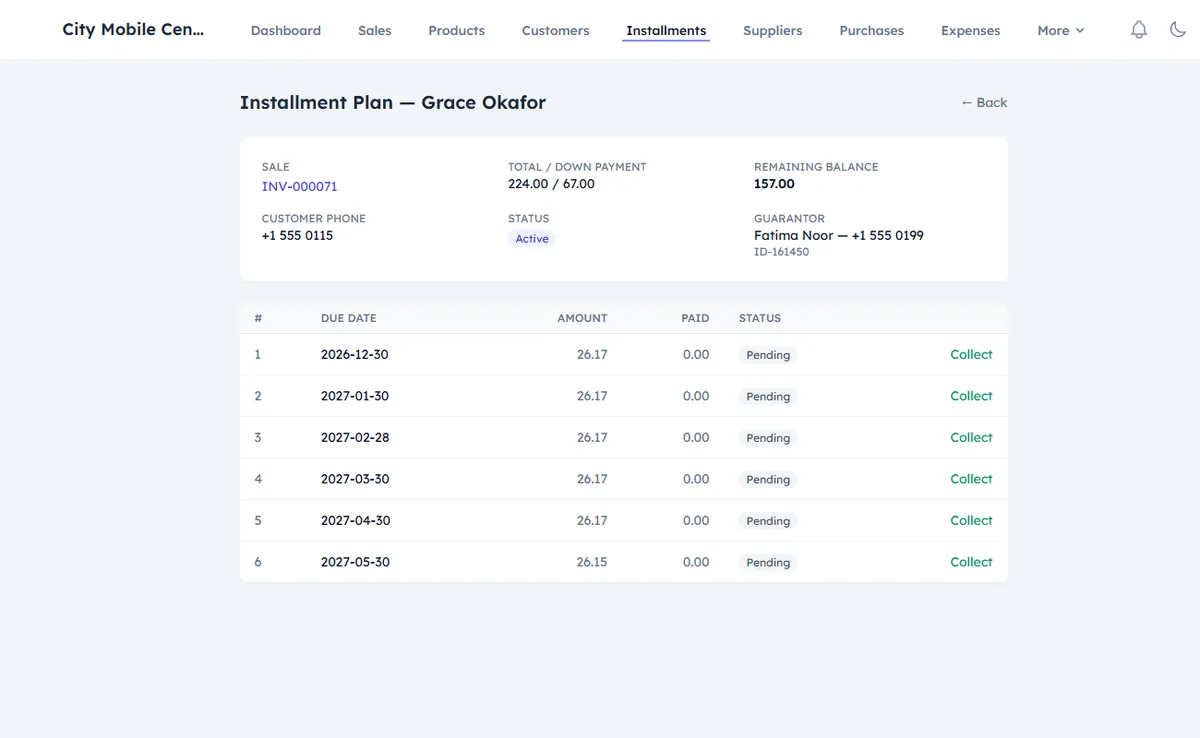
- The down payment, number of installments, amount and due date of each.
- Every payment received, its date and who collected it.
- The remaining balance, always up to date.
A paper register can hold this, but it can't tell you who is due today or add up balances for you. That is where software helps.
Step 4: Make collection a daily routine
- Each morning, check which installments are due today and which are overdue.
- Send a friendly reminder before the due date, not only after it's missed.
- Record payments the moment they're received, against the right installment.
- Contact the guarantor early — a week late is far easier to recover than three months late.
For a deeper look at recovery, see how to reduce installment payment defaults.
Step 5: Watch the numbers
Every week, look at three figures: total outstanding balance, amount overdue, and how much was collected. If overdue is growing faster than collections, tighten your rules — larger down payments, shorter terms or stricter guarantor checks — before it becomes a loss.
Running installment plans for free
MobiPOS, the free POS by HixCode, has in-store installment plans built in: choose Installment at checkout, enter the down payment and number of weekly or monthly payments, add the guarantor, and the schedule and invoice are created automatically. A due-today and overdue list tells you who to call. It's free for lifetime in every country, with no limit on customers, staff or branches.
Frequently asked questions
What is an in-store installment plan?
It is credit your shop gives directly: the customer pays a down payment, takes the item home and pays the remaining balance to your shop in fixed weekly or monthly installments.
Is in-house financing better than a buy now, pay later provider?
Neither is always better. A BNPL provider pays you up front and carries the risk but charges a fee and is only available in some countries; in-house plans keep the full margin and serve more customers but you carry the default risk and the collection work.
How much down payment should a shop ask for?
Many shops ask for 20–40% of the price, more for new customers, long terms or items that lose value quickly such as phones.
What software can manage in-store installment plans for free?
MobiPOS by HixCode is a free-for-lifetime POS with built-in installment plans: down payments, weekly or monthly schedules, guarantor records, due and overdue lists and payment history.